The Origins of Account-Based Marketing (Part 1 of 3)
B2B marketing did not always work the way it does today. Before account-based marketing (ABM) became standard practice, most B2B teams followed a very different approach, one that ABM was eventually built to replace. To understand what made ABM such a significant shift, it helps to first look at what came before it.
B2B Marketing Before ABM
For most of B2B marketing’s history, the dominant model was demand generation aimed at as wide an audience as possible. This approach, often called “spray and pray,” had a few defining characteristics:
- Campaigns were built around broad target personas or industries rather than specific named companies.
- Success was measured in volume: total leads captured, total downloads, total webinar sign-ups.
- Marketing handed off large batches of leads to sales, many of which had little real buying intent or fit.
- Sales teams spent significant time qualifying and disqualifying leads that marketing had already spent budget acquiring.
- Messaging was generic by necessity, since one campaign had to speak to hundreds or thousands of different companies at once.
This model worked reasonably well for lower-cost, higher-volume products, where a large number of small deals could offset a low conversion rate. It worked far less well for companies selling complex, high-value B2B products or services, where the buyer is not one person but a group of stakeholders inside a specific organization.
Defining Account-Based Marketing
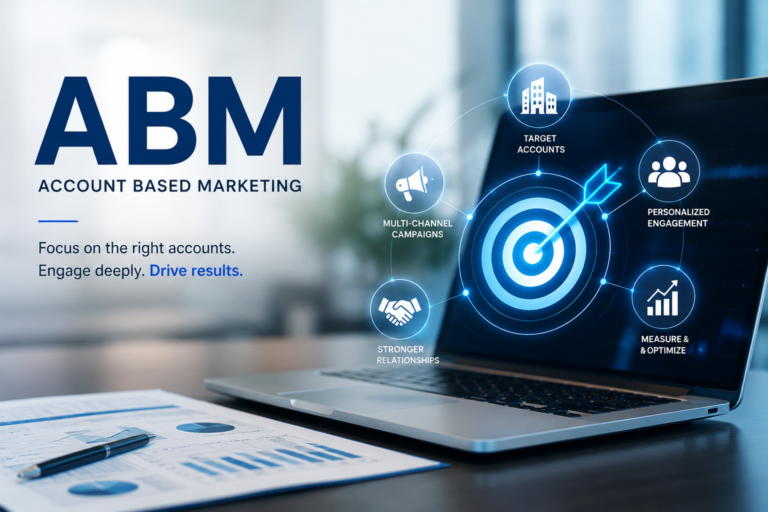
ABM flips the traditional funnel. Instead of casting a wide net and filtering leads down to find viable accounts, ABM starts by identifying the specific companies most likely to become valuable customers, and builds marketing and sales efforts around reaching the right people inside those companies.
At its core, ABM treats an account, not an individual lead, as the unit of marketing. A single target account might include multiple stakeholders: a decision maker, one or more influencers, a champion advocating internally, and someone in procurement, and ABM strategy is built to reach and engage all of them with relevant messaging, rather than treating each as an isolated lead in a funnel.
This concept was not new when it gained popularity. Enterprise sales teams had informally practiced versions of account-based selling for decades, running dedicated outreach for a handful of strategic accounts. What changed was that marketing teams began applying that same logic systematically, treating account-based targeting as a repeatable strategy rather than an occasional exception for the biggest deals.
The Impact ABM had on B2B Marketing
ABM addressed several of the core inefficiencies in broad demand generation. It brought tighter alignment between sales and marketing, since both teams worked from the same account list, so marketing stopped generating leads that sales considered a poor fit, and sales gained visibility into which accounts marketing was actively engaging. Budget saw better use on high-value opportunities, concentrating spend on the accounts most likely to convert into meaningful revenue rather than spreading it thin across a large, loosely qualified audience. Messaging became more relevant, tailored to a specific account’s industry, challenges, and stage in the buying process instead of relying on generic content built to apply to everyone. Metrics grew clearer and more meaningful, with engagement tracked at the account level rather than as raw lead volume, tying activity more directly to pipeline and revenue outcomes.
Where Early ABM Hit Its Ceiling
Early ABM delivered real results, but it also had a practical limit. Building personalized campaigns for each target account required significant manual effort, from research to content creation to media buying, which made it difficult to run true ABM against more than a small number of accounts at a time. Verifying that ads and content were actually reaching people at the right companies was also difficult without better data and targeting infrastructure.
That limitation set the stage for the next phase of ABM’s evolution, covered in the next part of this series: how programmatic, AI-driven technology took the account-based principle and made it scalable, verifiable, and far more precise, an evolution that programmaticb2b has built its approach around.